Articles in this Volume

Research Article Open Access
Research on production strategy optimization based on unconstrained programming models
Article thumbnail
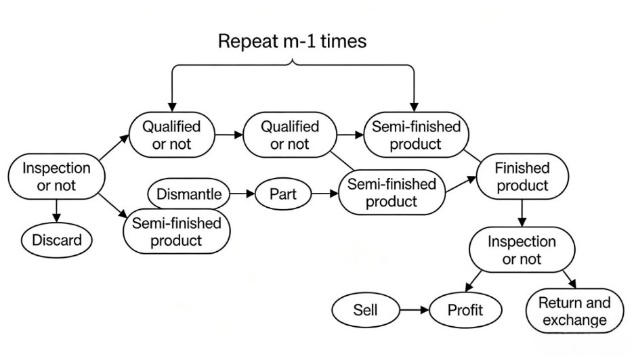
In the field of discrete manufacturing, particularly during electronic product assembly, quality fluctuations and cost control represent core challenges for enterprises. This paper addresses multi-stage production decision-making by constructing an integrated decision model that combines hypothesis testing, unconstrained optimization, and genetic algorithms. This model provides end-to-end support spanning sampling inspection, production process optimization, and robust decision-making under uncertainty.The model aims to maximize average profit by introducing 0-1 decision variables to characterize inspection and processing choices at each stage. It employs hypothesis testing to design minimum sample size sampling schemes, utilizes unconstrained programming for single-process and multi-process production decisions, and leverages genetic algorithms to solve large-scale combinatorial optimization problems. Under uncertainty, it characterizes defect rate fluctuations through confidence intervals, establishes robust decision models, and conducts sensitivity analysis.Numerical experiments demonstrate that the proposed model delivers effective and robust decision solutions across diverse scenarios, providing enterprises with systematic theoretical methods and practical tools to enhance quality control and economic efficiency.
Show more
Read Article PDF
Cite
Research Article Open Access
Research on the organizational change effect of AI technology embedded in human resource management: a multi-case configuration analysis
Article thumbnail
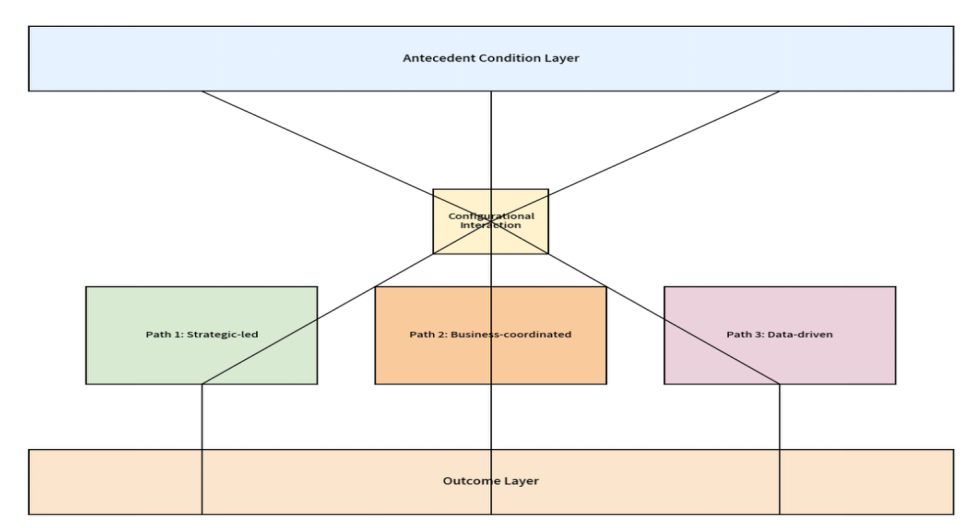
AI tech gets thoroughly rooted in company functions, and when it starts blending into human resource stuff, big changes happen to organizations, but it's mostly on the micro effects of singular AI tools. It doesn't look at how many org conditions together would affect change. This study bridges this gap by probing how configurations, made up of embedded technology depth, the cross-disciplinary area of human resources, organizational support structure, and data governance development, bring about those good organizational results. Using fuzzy-set qualitative comparative analysis on 6 different companies from different sectors, the research found that there are 3 equifinal pathways to substantial transformation: strategically led deep transformation, business-collaborative agile evolution, or data-driven progressive improvement. Organizational support became a necessary foundation condition. Strong cross-function collaboration and strong data governance can make up for a slightly shallower technology embedding. And provides configurational theories to the knowledge of AI-HRM literature and helps the managers make changes in organizations with AI.
Show more
Read Article PDF
Cite
Research Article Open Access
From CAPEX to OPEX: assessing the sustained impact of Energy-as-a-Service (EaaS) on PV-plus-storage adoption willingness in China's C&I sector
Against the backdrop of China's 'Dual Carbon' goals, a significant adoption paradox persists in the deployment of distributed PV-plus-storage systems across the commercial and industrial (C&I) sectors. The fundamental reason lies in the fact that under the traditional CAPEX model, business owners have to bear high initial investment costs and also lack operational resources. Based on the Service-Dominant (S-D) Logic and Transaction Cost Economics, this paper studies the role of the "Energy as a Service" (EaaS) model (referred to as EMC in China) in enhancing the willingness to lay out infrastructure. Empirical evidence shows that EaaS has significantly enhanced the willingness of business owners to invest by means of off-balance-sheet financing mechanisms and risk transfer. Although EaaS still faces issues such as credit risks and electricity spot market volatility, the model's market effectiveness has been confirmed through authoritative data and real cases.
Show more
Read Article PDF
Cite
Research Article Open Access
Operation and management innovation of small and medium-sized foreign trade enterprises in tourism-related supply chains: a case study of Hangzhou Hexun Industrial Co., Ltd.
With the rapid development of global tourism and the deep integration of the foreign trade industry and the tourism industry, small and medium-sized foreign trade enterprises (SMEs) engaged in the export of tourism-related products (such as hotel supplies, travel souvenirs, and outdoor sports equipment) are facing new development opportunities and challenges. However, most SMEs still adopt traditional operation and management models, which are difficult to adapt to the personalized and diversified demand characteristics of the tourism market. Taking Hangzhou Hexun Industrial Co., Ltd., an SME engaged in the export of tourism-related products, as a case study, this study adopts literature research, SWOT analysis, and case study methods to explore the specific problems of traditional operation and management models in tourism-related supply chains, such as disconnection from tourism market demand, single product structure, and weak supply chain coordination. Based on the WO strategy, an innovative operation and management model adapted to the tourism-related supply chain is constructed, covering tourism demand-oriented product development, supply chain coordination management, cross-border e-commerce channel expansion, quality management of tourism products, and professional talent training. The study further designs the implementation path and expected effect of the model, providing practical references for SMEs engaged in tourism-related foreign trade to enhance their adaptability to the tourism market and core competitiveness, and promoting the integrated development of the foreign trade industry and the tourism industry.
Show more
Read Article PDF
Cite
Research Article Open Access
Efficiency-enhancing mechanisms and implementation paths of AI-driven collaborative disaster information systems
With natural disasters occurring with increasing frequency, the gap between macro-level situational awareness and micro-level field information can substantially reduce the efficiency of emergency logistics. Drawing on differential game theory, this study develops a multi-stakeholder model involving the government, enterprises, and the public under a cross-sector disaster information-matching framework. It compares the optimal collaborative strategies and system-state evolution under a traditional model and an AI-enabled model. The results show that the AI-enabled bidirectional information-matching mechanism can effectively alleviate information silos and logistical blind spots. In addition, both the intensity of cross-sector disaster information matching and the level of public participation significantly increase collaborative investment by the government, enterprises, and the public, thereby generating a scale amplification effect. Further analysis reveals that the collaborative benefits of the system are constrained by the costs of AI adoption. Only when the net benefits generated by AI are sufficient to offset the costs of platform construction and application can participating stakeholders maintain incentives for sustained collaboration, thereby continuously improving overall emergency support performance. These findings provide a theoretical basis for breaking down information barriers in emergency logistics and optimizing emergency resource allocation and dispatch decisions.
Show more
Read Article PDF
Cite