


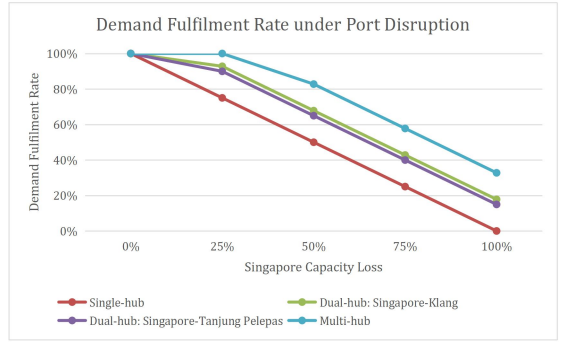
Major transshipment hubs improve operational efficiency through cargo concentration but can transmit local disruptions across maritime supply chains. Existing research recognises network redundancy yet insufficiently distinguishes the presence of backup hubs from their deployable capacity. Using Singapore, Port Klang, and Tanjung Pelepas as a regional case, this study compares four network configurations across five disruption scenarios. A linear programming model allocates cargo flows while evaluating demand fulfillment and relative total cost; sensitivity analysis examines backup capacity assumptions. The findings show that additional hubs do not automatically generate resilience. Service continuity depends on whether deployable backup capacity covers the demand shortfall created by disruption at the primary hub. Under a 75% capacity loss at the Port of Singapore, the multi-hub configuration achieved a demand fulfillment rate of 57.76%, which was 32.76 percentage points higher than that of the single-hub configuration, while recording a lower relative total cost of 445.78 compared with 750.00. Dual-hub configurations also performed differently because alternative ports varied in usable capacity and rerouting costs. Overall, redundancy improved both service continuity and relative cost performance when the disruption losses it avoided exceeded the additional coordination and rerouting costs. This paper therefore offers a conditional theoretical interpretation for effective network redundancy and proposes the principle of capacity‑matched selective diversification, which can guide the design of regional transshipment networks.