

About AORPMAdvances in Operations Research and Production Management (AORPM) is an open-access, peer-reviewed irregular journal hosted by Center of Management Case Studies, Beijing University of Technology and published by EWA Publishing. The journal bridges standardized theoretical modeling and factory industrial practice in operations research and production management, gathering insights from global management scholars, policy analysts and manufacturing practitioners, focusing on high-standard normative research with systematic scientific value, industrial decision-making reference value and full-chain industrial empowerment value, and provides data-driven modeling tools and full-chain upgrading decision references for management teachers, factory operation directors and supply chain consultants to exert the industrial decision-making value of operation research.For more details of the AORPM scope, please refer to the Aim&Scope page. For more information about the journal, please refer to the FAQ page or contact info@ewapublishing.org. |
| Aims & scope of AORPM are: ·Management Science ·Mathematics & Statistics ·Industrial Engineering ·Intelligent Engineering |
Article processing charge
A one-time Article Processing Charge (APC) of 450 USD (US Dollars) applies to papers accepted after peer review. excluding taxes.
Open access policy
This is an open access journal which means that all content is freely available without charge to the user or his/her institution. (CC BY 4.0 license).
Your rights
These licenses afford authors copyright while enabling the public to reuse and adapt the content.
Peer-review process
Our blind and multi-reviewer process ensures that all articles are rigorously evaluated based on their intellectual merit and contribution to the field.
Editors View full editorial board

Glasgow, UK
anil.fernando @strath.ac.uk

St Andrews, UK
bk78@st-andrews.ac.uk

Beijing, China
txw@bjut.edu.cn

Beijing, China
liyuchen@bjut.edu.cn
Latest articles View all articles
Fractals are extraordinary mathematical patterns that are mysterious, elegant, and full of endless mathematical charm.They are not just abstract math concepts,but are also everywhere in nature and daily life. From fern leaves and mountain contours to snowflakes and river networks, fractals show unique beauty in various forms. This paper seeks to the basic ideas of fractals through a rigorous research approach. It adopts dynamical analysis, numerical iteration, and fractal geometry to investigate the fundamental concepts of fractal, including its definition, core properties and classical models such as the Mandelbrot set. The Koch Snowflake and the Sierpiński Triangle are discussed as typical examples to show three main features of fractals: self-similarity, fractal dimension, and complexity from simple rules. Additionally,this paper also summarizes some promising directions for future research of fractal theory. It further explains why fractal geometry is important for people to understand the hidden mathematical rules in the universe. Learning fractals helps people see inherent order in the chaotic and disordered world, thus deepening the understanding of mathematics and nature.

 View pdf


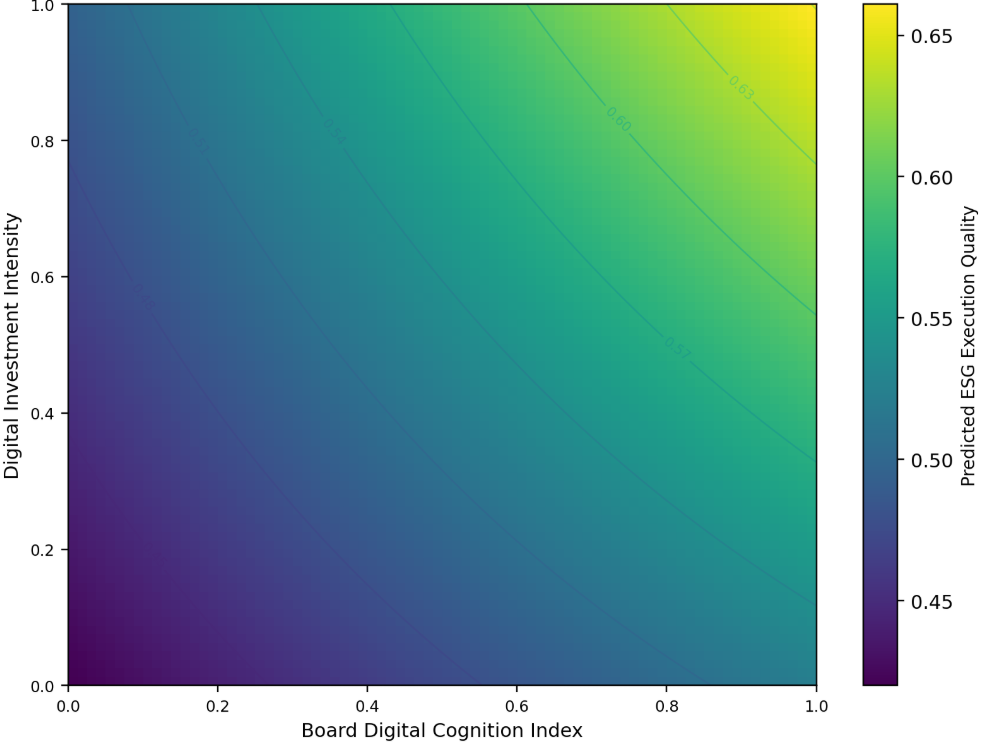
Against the background of deep integration between digital transformation and ESG governance, corporate ESG strategy no longer remains at the level of responsibility disclosure or image construction. It is gradually shifting toward target decomposition, resource allocation, process supervision, and performance improvement. As the core body of strategic decision-making and governance supervision, the board affects how firms understand ESG data, risk information, and execution processes through its level of digital cognition. Based on public disclosures of A-share non-financial listed companies from 2016 to 2023, the board digital cognition index can be constructed from directors' digital backgrounds, digital governance expressions, digital committee settings, and digital training disclosures. ESG strategy execution quality can be measured through target completion, quantitative disclosure, investment intensity, rating improvement, and penalty deductions. The baseline regression results show that board digital cognition has a significant positive effect on ESG strategy execution quality. The mechanism tests further show that internal control quality and digital investment strengthen this influence path. This finding indicates that board digital cognition not only reflects the upgrading of the governing body's knowledge structure, but also promotes the shift of ESG strategy from formal disclosure to substantive execution by improving information processing, supervisory constraints, and resource allocation.
View pdf
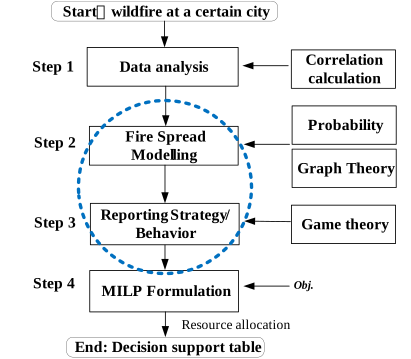
Wildfires are increasingly severe and frequent, necessitating efficient resource allocation strategies amid potential misinformation. This study proposes a novel framework integrating Game Theory and Mixed Integer Linear Programming (MILP) to optimize wildfire response. By modeling cities as rational agents in a repeated game, the framework introduces severity-dependent penalties for dishonesty and adaptive strategies to incentivize truthful reporting. The MILP formulation maximizes system-wide utility by weighting allocations based on true fire severity, damage-cost correlations, and penalties for misreporting. Simulations involving five U.S. cities demonstrate the model's effectiveness in balancing resource distribution, penalizing exaggeration, and prioritizing high-risk areas. Results highlight the importance of honest reporting and correlation-based allocation, offering actionable insights for emergency responders.
View pdf
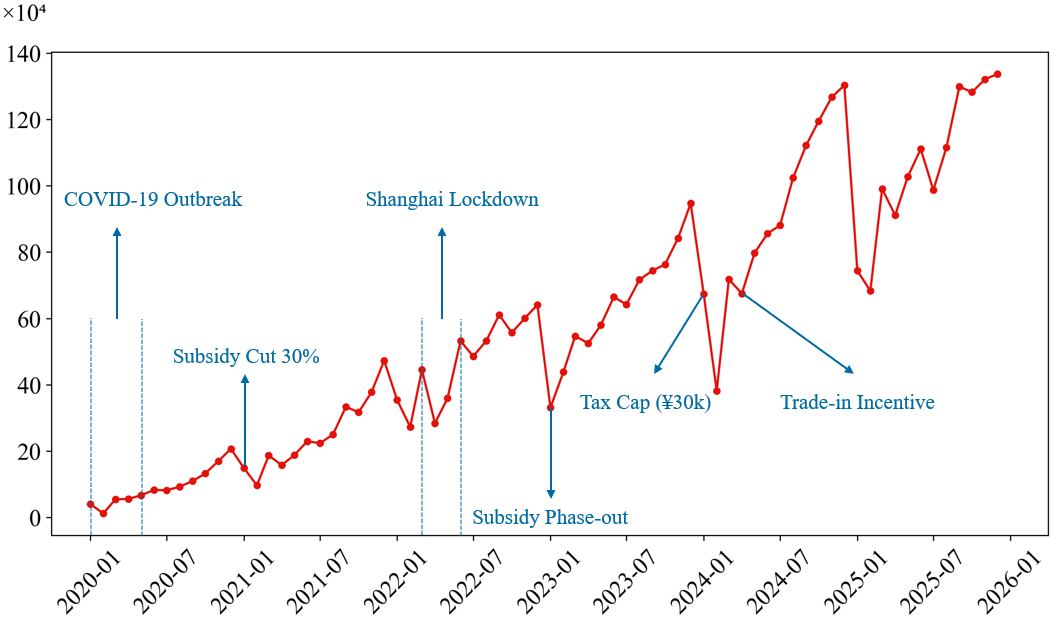
Accurate sales forecasting of new energy vehicles (NEVs) is critical for automakers, policymakers, and energy infrastructure planners. To address the multifaceted drivers of NEV sales, this study proposes a machine learning‑based forecasting framework using monthly data from China spanning January 2020 to December 2025. Two key innovations are introduced, namely a composite station factor that integrates charging station count, battery swap station count, and gasoline prices to capture infrastructure and fuel cost effects, and a time‑varying categorical variable that encodes major policy shocks, including subsidy phase‑outs, COVID‑19 lockdowns, purchase tax adjustments, and trade‑in incentives. A systematic comparison of multiple models shows that XGBoost equipped with the proposed features achieves the best performance, with a MAE of 61,169, RMSE of 71,972, MAPE of 6.09%, and SMAPE of 6.00%. This represents improvements over the univariate baseline of 62.76% in MAE, 63.14% in RMSE, 63.62% in MAPE, and 63.19% in SMAPE. Finally, ablation experiments and SHAP analysis are performed to validate the effectiveness of the proposed features. The findings demonstrate that the proposed framework offers a practical and interpretable tool for NEV sales forecasting and policy simulation.
View pdf
Volumes View all volumes
2026
Volume 5September 2026
Find articlesVolume 5May 2026
Find articlesVolume 5September 2026
Find articles2025
Volume 4November 2025
Find articlesVolume 4November 2025
Find articlesVolume 4July 2025
Find articlesAnnouncements View all announcements
Advances in Operation Research and Production Management
We pledge to our journal community:
We're committed: we put diversity and inclusion at the heart of our activities...
Advances in Operation Research and Production Management
The statements, opinions and data contained in the journal Advances in Operation Research and Production Management (AORPM) are solely those of the individual authors and contributors...
Indexing
The published articles will be submitted to following databases below: